

Promises to Laos
11/13/2025
My fingers run over his arm, covered in tattoos.
He smiles, sensing how I’m studying him — as if waiting for the moment my fingers stop with a question.
A tiny blue and red flag, one I had never known before.
— It’s my promise, — he sighs, still gazing at the ocean. — A promise that I will never go back there again.
I stay silent, waiting for an explanation. He knows I’m waiting.
— I have never found a place more beautiful. I don’t want to know that it’s changed, — he finally says, and after holding me in his arms for a moment, he leaves.
That morning happened eight years ago. Back then, as I walked him through the yard overgrown with palms, I believed we would soon find our way back to each other.
Years passed — he kept returning in letters, caring for me from afar, telling stories about new places I should see, but he never again appeared at my door.
It took time before he finally spoke — before disappearing for good.
For him- Both Laos and I me, have the same destiny.
I expected nothing from this country. Too many times I had wished for too much — and too many of those times ended in disappointment.
Laos didn’t seem like a dream destination: no easy travel routes, no grand tales, and worst of all — no ocean shore.
I thought I’d stay for a few weeks.
But as the last days of the month passed, I marked each one with tears.
It seemed nothing had changed since that morning when I found the tattooed Lao flag with my fingers — until today, when, having found this country. I made a promise completely different from the one my former lover had made.
I never liked children. How and why I ended up in a remote village teaching English — only God knows.
When asked which age group I preferred, I said - I don't care.
Maybe that’s why I was given a class of teenagers.
The only class that didn’t run to hug their teacher.
The only one that looked at you cautiously, keeping their distance.
And though at first I wasn’t eager to work there, within minutes I knew I would stay.
And the longer — the better.
My partner in the classroom was Tui.
And if I ever speak or write about Laos, he will live in every sentence.
He grew up hiding in holes so that the terrorists raiding his village wouldn’t see him and shoot him.
As a child, he promised himself he would learn another language, though, truthfully, even it seemed impossible.
“I used to read any book in English I could find,” he told me with flawless pronunciation, using words that made my vocabulary feel ashamed.
While waiting for the children to gather, we would watch the rice fields bathed in sunset light.
He would tell me about the cruelty and beauty he had seen and lived, about the extraordinary human will to forgive.
Tui somehow never saw me as different — as often happens when Westerners meet Asians. From the beginning, he allowed me to be his friend, no matter how differently we had grown up or how differently we would grow.
And while Tui and I leaned over the windowsill talking about life, that invisible wall of silence between me and my students began to crumble.
Every day someone would come up and shyly pat my hand or back.
Another learned to “give five” at the end of class.
Soon, one or two became brave enough to hug me when no one was watching.
And that’s how we all grew together through those weeks — until one morning, before class, I heard a rehearsed sentence, not a single word pronounced correctly, yet it remained the most beautiful jumble of words ever said to me.
— Deep in my heart, I’m afraid you’ll succeed, Tui, — I said one night as we walked home from school. — Those who suddenly start to succeed — they change. And most of the time, not for the better.
He stayed silent for a while. After what felt like too many seconds, I saw a small nod.
— You’re probably right, — he finally said, and we both sank into our thoughts — about all those who had succeeded, and because of that, we no longer wanted to know them.
What I dreaded most was saying goodbye to him.
I didn’t know — and still don’t — what to wish for someone like him.
Because more than anything, I wanted him to stay exactly as he was.
Someone who would always put others first.
Someone who, hearing that you felt scared walking a certain stretch of road alone, would make sure he — or someone else — walked with you.
A man who could sit quietly in thought, then, catching your gaze, smile the warmest smile in the world.
Not because he understood why you were looking at him — but because you smiled. And that was reason enough.
The full moon hung above us, and we all stood in a line, tilting our chins at just the right angle.
— Can you see it now? — I asked, hearing childlike gasps from adult mouths.
Few people have ever noticed the rabbit in the middle of the moon.
Few, because most simply don’t have time for standing still and looking up.
But we — travelers from different countries and corners of Laos — decided that, at least for a moment, we would have time.
A moment later, I dove into the lagoon and swam toward the moonlit reflection on the water. Only he and me were there.
Surrounded by mountains embraced by clouds, with stars flickering like they’d lost their minds, I couldn’t believe such days and nights could exist.
Silence.
Just me, the shimmering world, and a Frenchman telling his story.
And for the first time, I realized I no longer missed the ocean. I didn’t miss anyone anymore.
That feeling was so strange, so unexpected, it was almost frightening — as if losing a small piece of myself and waiting to see what would happen.
But nothing did.
— Remind me tomorrow to believe it, — I said, sinking beneath the water.
I heard him speaking — but not what he said.
The water of the lagoon flowed between us, muffling his words, leaving only his accent.
I surfaced beside him, looking at this young man — one who fit perfectly into the beauty of Laos.
And I thought how generous and cruel fate can be at the same time.
— “Bavoiu,” — I heard him chuckle, and I began to be jealous for his future wife.
Maybe people under thirty still believe the world will always be as beautiful as we found it here.
Almost a month passed before I finally forced myself to leave.
I wanted a long goodbye with this country, so I took a slow, several-day journey down the river that would carry me away — otherwise, I might never have left of my own will.
I thought I’d sort out my thoughts, finally find some peace.
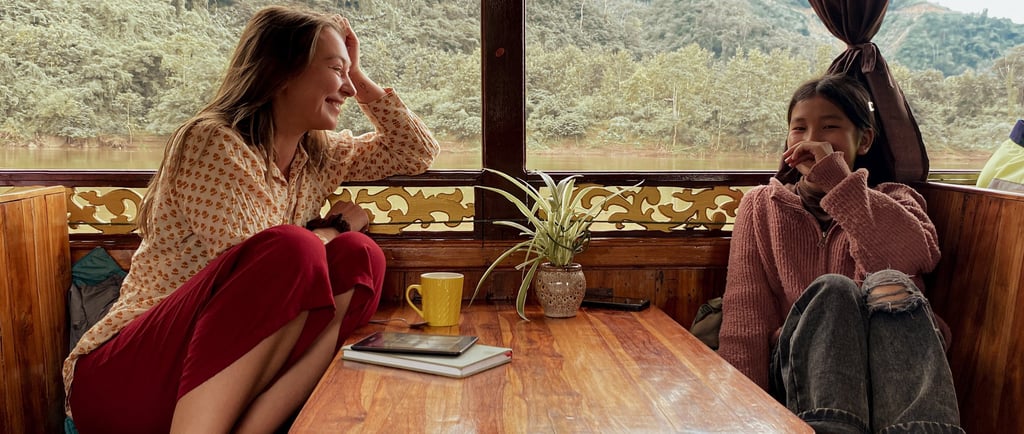
Unexpectedly, a tiny girl jumped onto the boat.
Her grandmother waved from the shore, and after scanning all the passengers, the child chose me as her seatmate.
For a good hour, she studied me with the same observant eyes as the children in class.
Eventually, she opened a small bag of rice and, rolling little balls with her fingers, ate some herself, then insistently offered me some too.
After finishing the rice, we peeled bananas.
We said nothing, just looked at each other and laughed the entire time.
From Laos, I was bringing a bar of chocolate for my friend.
When the girl received it, she unwrapped it and still offered me half.
Finally, when the boat stopped briefly, she got off into the bushes, crawled up a nearby hill, and waved to me until she disappeared around the corner.
Most people on the boat probably didn’t understand what had happened between us — why we laughed without a single word spoken.
And so, we remained in a Japanese traveler’s photo album — one picture more meaningful than all the sentences I could ever write here.
I wish I could tell him he was wrong.
That there are many corners of the world doomed to change — and to change fast.
But not this one.
Here, traveling is still hard and exhausting, and as long as it stays that way — nothing will change.
People here still haven’t learned to fool you, haven’t learned to put themselves first.
“Same same but different,” repeat the villagers. Some don’t even understand what it means, but they like the way it sounds, so they say it whenever they can — laughing as they do.
And I watch them, smiling, realizing that all the years I spent wandering the world, not quite knowing what I was searching for, had led me here — to this place where there is nothing, and yet, finally, everything is enough.